
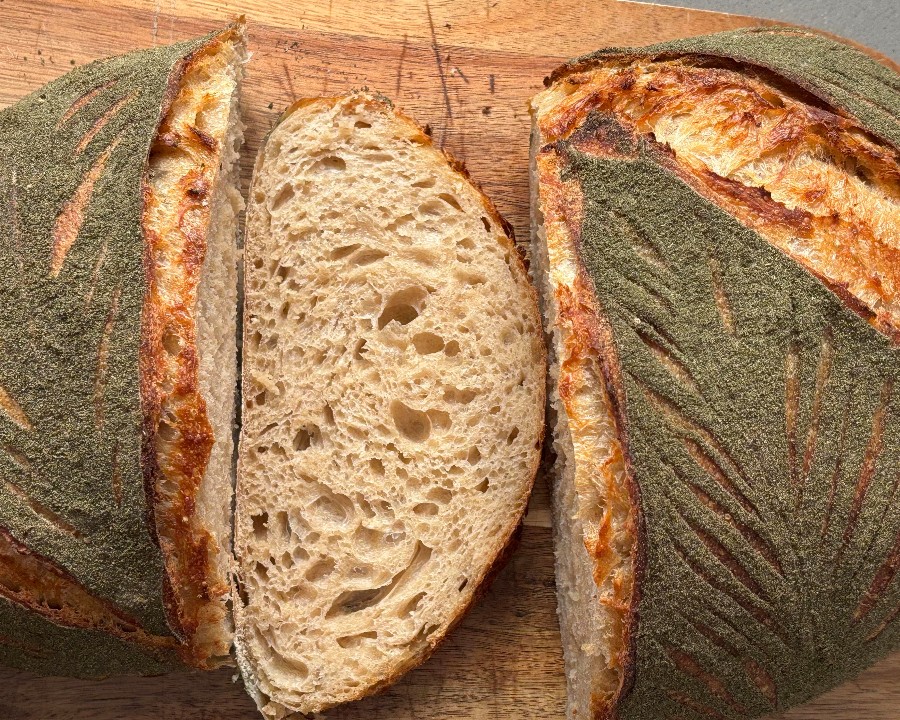
Your dough has been shaped. It’s been cold-proofing in the fridge overnight, growing slowly, developing flavour, firming up into something beautifully taut. You passed the poke test in Part 3. Now it’s time to bake.
Part 4 is the most visual, most sensory, most satisfying stage in the entire sourdough process. We’re covering the two things that transform a cold lump of dough into a crackling artisan loaf: scoring and baking. Get these right, and everything you’ve built over the last three posts pays off in one spectacular oven moment.
Two things beginners most commonly get wrong at this stage: scoring too slowly with a hesitant hand, and opening the Dutch oven lid too early. This post will make sure you do neither.
🔥 Before You Score: Preheat Everything
The single most impactful thing you can do for your home sourdough bake costs nothing and takes zero skill. Preheat your Dutch oven inside your oven for a full 45 to 60 minutes before baking. Not 20 minutes. Not while the oven is still coming to temperature. A full hour of preheating with the Dutch oven inside, lid on.
This is non-negotiable because a professional bread oven has thermal mass — thick stone walls that radiate intense, even heat the moment dough is loaded. Your home oven has none of that. A preheated cast iron Dutch oven is your workaround. It stores heat and transfers it directly to the base of your loaf, producing the oven spring and bottom crust that make sourdough recognisably sourdough.
🌡️ Oven Temperature Guide for Australian Home Ovens
Every oven runs differently. These temperatures are dial settings — use an oven thermometer to verify your actual temperature, as many domestic ovens run 10–20°C hotter or cooler than displayed.
- Fan-forced (most Australian ovens) — set to 220°C — Fan circulates heat aggressively, so lower the dial slightly from what a conventional recipe states. Actual baking temp: ~220–230°C.
- Conventional (top and bottom elements) — set to 240°C — Slower heat saturation requires a higher dial setting. Preheat for the full hour.
- Gas ovens — set to 230°C — Gas ovens often have hot spots. Rotate the Dutch oven at the 20-minute mark during covered baking.
- Small apartment ovens — set to maximum — If your oven tops out at 220°C, use it. Longer covered baking time (25 min instead of 20) compensates for lower peak temperature.
- Preheat duration — minimum 45 minutes, ideally 60 — The Dutch oven needs to reach the same temperature as the oven air. This takes longer than the oven itself.
✂️ The Art of Scoring Sourdough
Scoring is not decoration. It is function. When dough hits a hot oven, it expands rapidly — this is called oven spring, and it happens in the first 10 to 15 minutes of baking. Without a score, the expanding gas finds its own weak points and bursts through unpredictably, giving you a loaf that has “blown out” at the sides or base.
A scored cut is a deliberate weak point — a controlled release valve that directs the oven spring upward, creating that iconic “ear” or ridge along the cut line and producing a loaf with maximum volume and a dramatic, open crust.
🗡️ How to Use Your Bread Lame
-
1Set Up Your Scoring StationWork directly from the fridge — do not let your shaped dough warm up before scoring. A cold, firm loaf is dramatically easier to score cleanly than one that has softened at room temperature. Have your Dutch oven preheated in the oven, your lame ready, a sheet of baking paper cut slightly larger than your loaf, and a steady surface. You are working fast once the oven door opens.💡 Cut a sling of baking paper before baking day so you’re not scrambling while the Dutch oven is hot. Two strips criss-crossed under the loaf gives you handles to lower it safely.
-
2Flip the Dough Out of the BannetonPlace your sheet of baking paper directly on top of the banneton, then place a flat board or baking tray on top of that. In one smooth movement, flip the whole assembly upside down so the banneton is now on top. Lift the banneton away — your loaf should release cleanly, smooth side up, sitting on the baking paper. If it sticks, you need more rice flour next time. Gently ease it free without deflating the loaf.💡 Any condensation on the surface of a cold-proofed loaf is normal and actually helps the lame blade glide cleanly. Do not pat it dry.
-
3Hold the Lame at the Correct AngleFor a curved lame (as included in the Hankerie kit): hold it so the blade curves upward — the arc faces away from you. Angle the blade at 30 to 45 degrees to the surface of the dough, not straight down. This shallow angle is what creates the ear — the flap of dough that lifts up and caramelises into the dark, crackling ridge. A 90-degree straight-down cut produces a flat, open score without an ear.💡 Hold the lame like a pen, not a knife. Long handle, relaxed grip, wrist driving the motion rather than the fingers.
-
4Make the Cut — DecisivelyFor your first loaf: one straight cut, slightly off-centre, running most of the length of the loaf. Aim for 1 to 1.5cm depth. Use your whole arm — not just your wrist — in one fluid motion from one end of the loaf to the other. Do not stop midway. Do not go back for a second pass on the same line. The cut is done in under a second. You should see the dough open slightly and the flap begin to peel back — this is exactly right.💡 If your blade drags rather than cuts, your lame blade needs replacing. Fresh blades are razor-sharp. The Hankerie kit includes 5 spare blades — change them regularly, not just when they feel dull.
-
5Straight to the Dutch OvenThe moment scoring is complete, move immediately. Open the oven, carefully remove the scorching-hot Dutch oven lid (use thick oven mitts — cast iron retains heat ferociously), lower the loaf into the Dutch oven using the baking paper sling, replace the lid, and close the oven door. This entire sequence should take under 20 seconds. Every second the scored dough sits at room temperature, it is softening and losing the firm structure that makes it spring upward.💡 Leave the baking paper under the loaf — it prevents sticking and makes removing the loaf after baking effortless. It will brown but will not burn at these temperatures.
✏️ Scoring Patterns: Start Simple, Build Confidence
Every pattern below produces a different result in terms of oven spring direction, ear formation, and visual presentation. Master the single score first — then experiment once you have a feel for how your dough responds.
One diagonal cut, slightly off-centre. Directs all oven spring in one direction, creating a dramatic single ear. The most reliable score for a first loaf.
Two perpendicular straight cuts forming a cross. Even spring in all directions. Great for round boules. No pronounced ear — more rustic, open look.
Three evenly spaced diagonal cuts. Produces a beautiful ribbed crust. Each cut must be the same depth for even spring. Striking visual on an oval loaf.
Central spine with angled cuts branching off. Decorative and structural. Requires a steady hand and sharp blade. Stunning on a well-shaped oval loaf.
Crossing diagonal lines forming a diamond pattern. Requires consistent depth and spacing. Impressive when executed well — and forgiving of slight unevenness.
Radiating cuts from a central point. Best on round boules with a firm, cold surface. Each cut must be equal length and depth. The showstopper of the scoring world.
🍞 The Bake: Two Phases, One Perfect Loaf
Sourdough baking in a Dutch oven has two distinct phases. Each does something different to the loaf. Understanding both phases tells you exactly what is happening inside your oven — and why you must not rush from one to the other.
| Phase | Duration | Temp (Fan-Forced) | Lid | What’s Happening |
|---|---|---|---|---|
| Phase 1 Steam bake |
20 min | 220°C | ON 🔒 | Steam from the dough is trapped under the lid, keeping the crust soft and extensible so the loaf can fully expand. This is where oven spring happens. Do not open the lid. |
| Phase 2 Crust bake |
20–25 min | 200–210°C | OFF 🔓 | Steam escapes, the crust begins to dry and caramelise. The Maillard reaction creates that deep amber-to-mahogany colour and the complex, roasted flavour of a proper sourdough crust. Drop temp slightly to avoid burning. |
🔬 The Science of Steam — Why the Lid Matters
Steam performs two essential functions in Phase 1 that no other method replicates in a home oven.
- Gelatinises the surface starch — Steam keeps the outer crust moist and pliable, allowing the dough to continue expanding as the interior heats. Without steam, the crust sets hard within the first few minutes and restricts oven spring.
- Creates the crust’s sheen — The gelatinised starch layer is what produces that characteristic glossy sheen on artisan sourdough. It also gives the crust its crisp, shattering texture after cooling.
- Prevents premature browning — Without steam, the Maillard reaction begins too early. The outside burns before the inside is fully baked. Steam delays browning until Phase 2, when you want it.
- Dutch oven advantage — The loaf itself generates sufficient steam inside the sealed Dutch oven. This is exactly why no additional water, ice cubes, or steam injection is needed — unlike in a conventional oven where steam escapes immediately.
⏳ The Hardest Part: The Cooling Wait
When you pull your loaf from the oven, it will look and smell perfect. The crust will be crackling as it cools — that sound is moisture escaping through the crust as the loaf equilibrates to room temperature. It is one of the most satisfying sounds in baking.
And you must not cut it yet. Wait a minimum of one hour. Two hours is better.
THE CRACKLING SOUND — WHAT IT MEANS
That rapid ticking and crackling as your loaf cools is moisture migrating outward through the crust and evaporating. The internal crumb is still actively setting — the starch structure is firming, the crumb is developing its final texture, and excess moisture is redistributing from the centre outward. Cutting into a hot loaf releases all of this trapped steam at once, giving you a gummy, compressed crumb that never recovers. The patience of an hour produces a loaf that slices cleanly, with an open, airy crumb and a crust that shatters rather than compresses.
-
1Transfer to a Wire Rack ImmediatelyRemove from the Dutch oven the moment it comes out of the oven and place on a wire rack. If it sits in the Dutch oven while cooling, the residual heat and trapped steam softens the base crust. A wire rack allows air to circulate under the loaf, keeping the bottom crust as crisp as the top.
-
2Listen for the Crackling to SlowActive crackling means the loaf is still releasing steam. When the crackling slows to occasional pops — usually 30 to 45 minutes in — the exterior is set. The interior still needs time. The full wait is non-negotiable for a clean crumb.
-
3Read the Crust ColourDeep amber to mahogany brown means proper caramelisation and flavour. Pale gold means the loaf needed more time in Phase 2 — add 5 minutes next bake. Dark brown to black patches near the score line are normal and desirable — this is where the Maillard reaction is most intense and where your loaf will taste the most complex.
-
4The Hollow Thump TestTurn your cooled loaf upside down and knock the base firmly with your knuckle. A hollow, resonant sound means a fully baked, well-structured crumb. A dull, dense thud suggests the centre may be under-baked — return it to a 200°C oven directly on the rack for 10 more minutes.
🛠 Quick Bake Troubleshooting
| What You See | What Went Wrong | Fix It Next Bake |
|---|---|---|
| Flat loaf, spreads sideways | Over-proofed dough or weak shaping | Reduce bulk ferment time by 30 min; tighten shaping tension |
| No ear on score line | Blade angle too steep (90°) or score too shallow | Hold lame at 30–45°, cut 1–1.5cm deep in one fast stroke |
| Pale, thick crust | Oven or Dutch oven not hot enough | Extend preheat to 60 min; verify oven temp with thermometer |
| Burnt base, pale top | Dutch oven position too low in oven | Move Dutch oven to middle rack; line base with extra baking paper |
| Gummy, dense crumb | Cut too soon, or under-baked | Wait minimum 1 hour before cutting; check hollow thump test |
| Loaf bursts at the side | Score line too short or too shallow to contain expansion | Score from end to end, full depth — give the gas a clear exit |
| Crust softens after cooling | Stored in airtight container too early | Cool fully (2 hrs) before storing; use a paper bag, not plastic |
The Lame That Makes Every Score Count
Every score in this post was made with the stainless steel bread lame included in the Hankerie Starter Kit — curved blade, ergonomic handle, and 5 replacement blades so you’re never working with a dull edge. Pair it with the kit’s oval banneton, heritage starter, and digital masterclasses for everything you need to go from this post to a golden loaf in your own oven.
🌿 What’s Coming in Part 5
You’ve now baked your first sourdough loaf. But here’s something most beginners don’t discover until much later: the off-cuts, the excess starter from your daily feeds, the dough you trim — none of it needs to be thrown away. In Part 5, we go deep into sourdough discard — the zero-waste side of sourdough baking that produces some of the most delicious food to ever come out of a home kitchen.
Sourdough discard pancakes, crackers, flatbreads, and muffins. All from what you would otherwise pour down the sink. Subscribe to the Hankerie newsletter and it lands directly in your inbox.
📚 The Hankerie Sourdough Series — All 6 Parts
- 01 Why Every Australian Kitchen Needs a Sourdough Starter ✅
- 02 How to Activate & Feed Your Sourdough Starter (The Right Way) ✅
- 03 Your First Sourdough Loaf: Mixing, Folding & Shaping for Beginners ✅
- 04 Scoring & Baking: How to Get That Golden Crust in a Home Oven — You are here ✅
- 05 Sourdough Discard 101: Zero-Waste Recipes That Actually Taste Amazing
- 06 Troubleshooting Your Sourdough: Why It’s Dense, Flat, or Not Rising
Want to score your first loaf with Han Ker standing beside you? Join the Hankerie Ryde Studio Sourdough Beginner Masterclass — just 5 students, full hands-on baking from mix to score. See upcoming class dates →
For more Lamination & Scoring Video: Watch the Artistry Guide →
Based at the Ryde Studio, Sydney NSW · hankerie.com